Available homes
Discover the homes currently available across Landcom communities and find the right opportunity to buy with Landcom.

Discover the homes currently available across Landcom communities and find the right opportunity to buy with Landcom.


Discover how Landcom engages with residents, councils and stakeholders to create affordable, sustainable and inclusive communities.
Find out more
Stay up to date with Landcom’s latest industry opportunities, including current tenders, upcoming projects, and ways to work with us.
Find out more Major milestone reached for Lismore Build-to- Rent homes
 Landcom celebrates making 110,000 homes happen
 Final year UNSW Sydney architecture students take on housing challenge
 Growing food and density together
 Creating a Spark: Energy Sharing Communities
 Valuing Creative Placemaking Toolkit
'In the Making' will showcase the projects, places and positive impacts we’re delivering across NSW. Explore the first quarterly edition and stay connected as this work evolves.

Explore Landcom’s teams and discover the diverse careers we offer. See how our people work together to create sustainable, inclusive communities.

Discover Landcom’s culture, values and behaviours, and see what makes our workplace inclusive, collaborative and focused on creating real impact.

Landcom is the NSW Government’s land and property developer. We work with government to unlock land...

Major milestone reached for Lismore Build-to- Rent homes
Landcom celebrates making 110,000 homes happen
Final year UNSW Sydney architecture students take on housing challenge

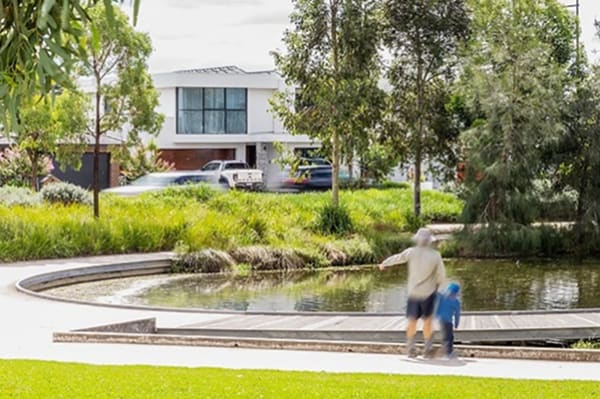
Landcom is excited to release a new report on the urban heat island effect titled ‘Cooling Common Spaces in Densifying Urban Environments’ that offers ways to address the very serious issue of rising heat levels in urban environments.
Landcom Director of Sustainability and Learning Lauren Kajewski, said that Landcom partnered with the Institute for Culture and Society at Western Sydney University (WSU) and the University of Technology Sydney (UTS) on this report to offer new ways to cultivate cool outdoor common spaces or ‘commons’, and enhance liveability in warming cities.
“The research identifies patterns for outdoor common spaces to combat the urban heat island effect which is a particularly acute problem for Western Sydney, where temperatures are expected to peak at 50°C in built environments by mid-century.
“The report identifies ways in which the pre-planning of developments can embed more effective design approaches – or ‘Cooling the Commons patterns’ – to help reduce the impact of the urban heat island effect.
“Integrating such patterns into a site or precinct design can have a marked effect on the liveability of a community.
“By ensuring larger tree canopies, temporary use of public space to maximise sun shade, better public accessibility of water such as taps and drinking fountains, and a greater focus on night-time uses of public space when the temperature is naturally cooler, engagement with commons can be amplified,“ Ms Kajewski said.
Associate Professor in Design Studies at UTS Abby Mellick Lopes, who led the project in her previous role as a School-based Researcher at the Institute for Culture and Society, Western Sydney University, said that the ‘cooling patterns’ identified in the report reflect both urban design and people’s social activities.
“The concept of common spaces or ‘commons’ means that they are accessed, enjoyed and cared for by the community, which make them a central part of where and how we live,” Associate Professor Lopes said.
Importantly, the research found many aspects of community life are being compromised by the retreat into private air-conditioned environments, which is rapidly becoming a design and social norm.
The Report calls for greater consideration of the connection between social practices and natural and built environments, and shows how thoughtful design at all stages of the development process can cool public outdoor space and improve community experience.
Ms Kajewski said that the practical solutions identified in the report support the environmental and social resilience of our projects to the changing nature of cities, people and communities.
“Landcom is very proud to lead the way in looking at how we can improve the social and environmental sustainability of built environments and we are already implementing some of these patterns within our projects at Macarthur Heights and Schofields.
“Upcoming projects are opportunities to test more patterns and to continue researching the urban heat island effect to improve the resilience and liveability of our communities,” Ms Kajewski said.

A proposal for a development that will deliver up to 32 affordable housing dwellings on a Council carpark in Mullumbimby will move to tender after…
26 Aug 2022
Biraban Local Aboriginal Land Council (LALC) and Landcom have signed a Memorandum of Understanding (MoU) which will see both parties work in partnership to identify…
8 Feb 2022
Landcom has successfully concluded the sale of development sites at Thornton in Penrith, and a portion of Precinct 9 at Edmondson Park to Urban Property…
20 Dec 2021Stay up to date on insights into our plans, projects and partnering opportunities